

| Year | Make | Model |
|---|---|---|
| 2009-2023 | Nissan | 370Z I (Z34) |
1
/
of
2
HKS Carbon Fiber Canards | Nissan 400Z RZ34 (23+) (53004-AN002)
HKS Carbon Fiber Canards | Nissan 400Z RZ34 (23+) (53004-AN002)
SKU:53004-AN002
Out of stock
Regular price
$1,540.00 USD
Regular price
Sale price
$1,540.00 USD
Unit price
/
per
Couldn't load pickup availability
▶ Vehicle Fitments
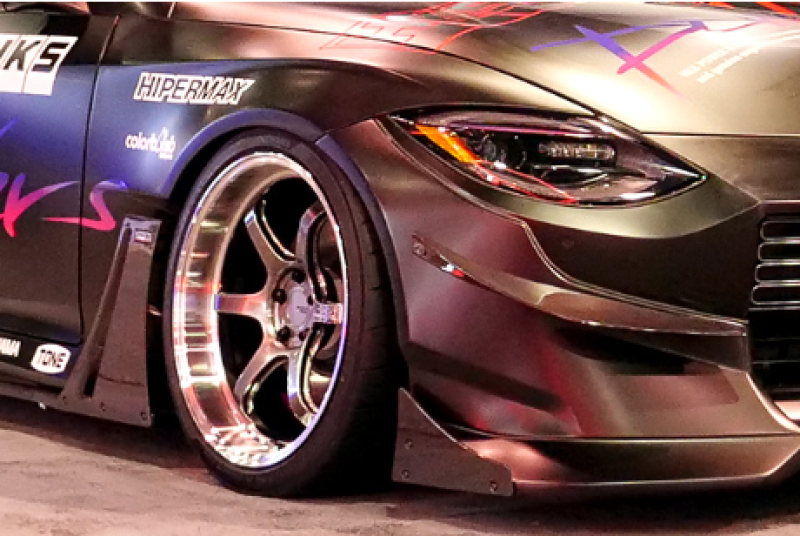
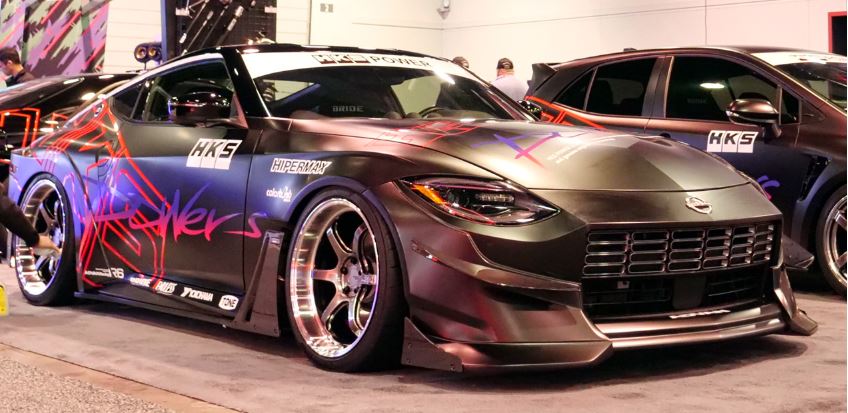
The HKS Carbon Fiber Canards for the Nissan 400Z RZ34 (23+) are race-inspired aerodynamic components designed to enhance both performance and visual appeal. Constructed from lightweight carbon fiber, these canards provide increased downforce and improved airflow management, contributing to better stability at high speeds. Their aggressive, wide-body styling draws from HKS's legacy of time attack engineering, offering a bold, track-ready appearance that complements the vehicle's aerodynamic profile. The design balances functional performance with aesthetic impact, making the car stand out with a race-inspired look while optimizing aerodynamic efficiency.
These canards are specifically engineered for the Nissan 400Z RZ34 model years 2023 and onward, fitting vehicles equipped with wide rear tires in stock condition. They are intended for street and track use, providing an aggressive upgrade for enthusiasts seeking improved downforce and visual impact. Installation is designed to be straightforward, typically involving bolt-on mounting to the front bumper or fenders. The kit includes the carbon fiber canards, which are a direct replacement or upgrade for the factory components, ensuring compatibility with the vehicle's existing aerodynamics and bodywork.
Share
Overview
Overview
An aggressive wide-body kit that carries the legacy of HKS's relentless time attack machines. Designed for optimal aerodynamics and bold aesthetics, this kit enhances both performance and presence, making your vehicle track-ready with a striking, race-inspired look.
*SPECIAL ORDER
Application
- FAIRLADY Z CANARD
Features
- The design is based on the HKS racing style, but with a GT car design for the street. The design is designed for a vehicle that can be equipped with wide rear tires in stock condition, so it is not extremely wide, but for a vehicle that can be used for touring and sometimes for circuit driving.
- Expresses strength and sharpness. Carbon is used in key areas to create a racy and luxurious feel.
- The design is intended to embody the HKS racing style while still preserving the distinctive Nissan Z appearance. It features a sharp edge and follows the GT car style.
- Rectifying the airflow passage, it establishes an effective approach from the front to the under-panel. This substantially alleviates pressure on the underside of the front bumper and generates downforce.
-
The fender are crafted to replace the factory fender, eliminating the retrofit appearance.
The upper section of the fender features a pressed line, ensuring a continuous line from the door panel to the rear. Vortex generators are strategically positioned on the surface, extending from the fender to the side sills, effectively reducing driving resistance.
-
The simple side sills are designed to balance the genuine body design.While the concept is simplicity, the side sills are designed to look different when standing on the side of the vehicle.The barge panel, which is the identity of HKS Aero, is also set on the Z. The barge panel is designed to balance with the shape of the rear of the front fender.The size of the panel is designed to be balanced with the rear of the front fender.
- The canard and side barge panels also contribute to reducing overall pressure in the tire housing, resulting in increased downforce.
- As the vehicle can accommodate wide rear tires in its stock form, the design is not excessively broad but is tailored for circuit use while maintaining everyday touring functionality. The upper press line and concave shape at the rear were incorporated to provide a visually broad appearance with minimal added thickness. Press lines were introduced to the sleek design of the stock body, creating a GT car style, and the tire area was crafted to be sharp and tight. The result is a substantial visual width, reaching a remarkable +8mm per side.
- While there is ample space to significantly increase the size of the vehicle within Japanese car inspection standards, the design has intentionally been enlarged to a degree that is not overly radical.
- The thickness of the low-speed area in front of the ducktail has been augmented, demonstrating the spoiler's damming effect. This has led to an increase in velocity on the underside of the vehicle, as the airflow on the top of the vehicle is redirected upward, creating a suction effect on the underside flow